🧠 Background & Motivation
Micro- and nanoplastics are increasingly detected in food, beverages, and environmental matrices, raising concerns about their potential impacts on human health and gut microbiome stability. Nanoplastics derived from the degradation of common polymers such as polyethylene terephthalate (PET), polypropylene (PP), and low-density polyethylene (LDPE) can enter the gastrointestinal tract through diet and interact with resident microbial communities.
Inflammatory bowel disease (IBD), including Crohn’s disease (CD) and ulcerative colitis (UC), is characterized by chronic inflammation and microbial dysbiosis in the gut. Emerging evidence suggests that environmental toxicants such as nanoplastics may disrupt microbial communities, impair intestinal barrier function, and contribute to inflammatory responses.
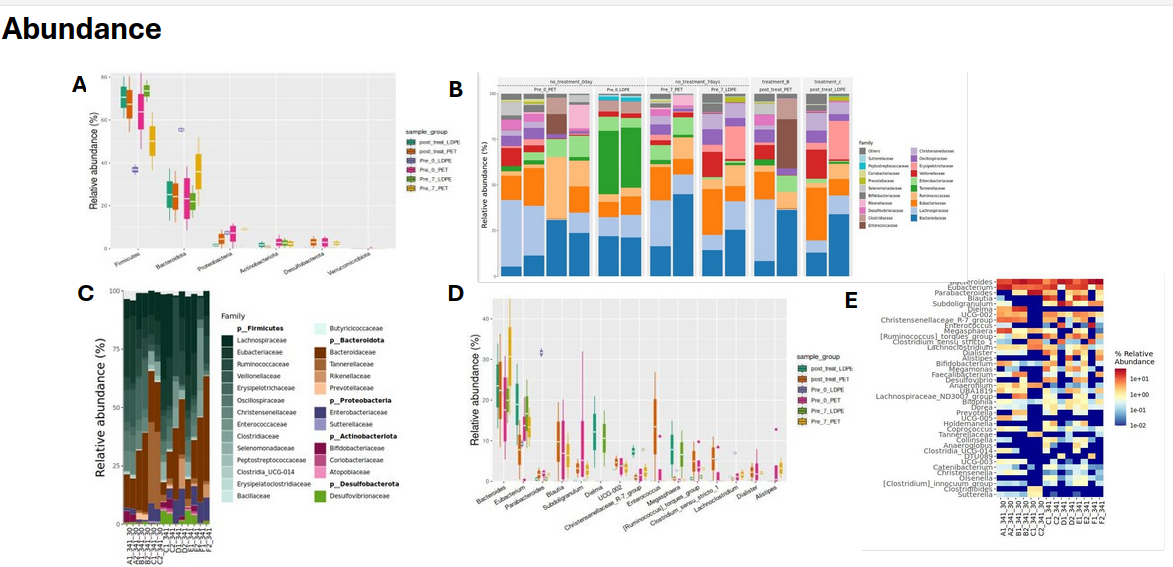
This project investigates how food-borne nanoplastics influence gut microbiome composition and metabolic activity, comparing responses between healthy individuals and IBD patients. The work integrates controlled in vitro colon fermentation systems with microbiome sequencing and functional analysis to better understand environmental drivers of gut microbial dysbiosis.
*📌 Study 1: Microbiome Response to Nanoplastics Exposure
*📌 Study 2: Functional Consequences of Microbiome Perturbation
My contribution focuses on microbiome sequencing, bioinformatics, and functional analysis, including:
Challenge 1: Detecting microbiome responses among low-abundance microbial taxa
Solution:
Applied multiple bioinformatic strategies including:
*Microbiome Sequencing
*Bioinformatics
*Statistical Analysis
This project provides new insights into how environmental nanoplastics may reshape gut microbial ecosystems, potentially contributing to microbiome dysbiosis and inflammatory diseases such as IBD. By integrating controlled experimental systems with microbiome multi-omics analysis, the study helps establish reproducible workflows for assessing environmental toxicants on human-associated microbial communities.
The findings will contribute to understanding the environment–microbiome–health axis, with implications for public health, environmental policy, and microbiome-based disease research.
Dr. Saji George
Associate Professor & Chair, Department of Food Science and Agricultural Chemistry
Canada Research Chair in Sustainable Nanotechnology for Food and Agriculture
Faculty of Agricultural and Environmental Sciences,
Macdonald-Stewart Building, Room-1033, Macdonald Campus, McGill University
21,111 Lakeshore, Ste Anne de Bellevue, Quebec, H9X 3V9, Canada. Email: saji.george@mcgill.ca
Unnikrishnan Kannan
PhD student
Food Science and Agricultural Chemistry
Mcgill University
Email unnikrishnan.kannan@mail.mcgill.ca
🖼 Image Gallery