Amplicon Week — Day 1: Introduction to 16S, ITS, 18S, 12S, and COI Metabarcoding
Welcome to Day 1 of my Amplicon Sequencing & Metabarcoding Week (Dec 8–13)! Throughout this week, I will walk through complete, reproducible workflows for 16S, ITS, 18S, 12S, and COI — from PCR primers to QIIME2 processing, visualization, functional prediction, and web-based tools.
🔬 What Is Amplicon Sequencing?
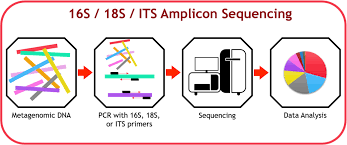
Amplicon sequencing targets specific marker genes using PCR primers designed to capture biodiversity within a taxonomic group. After sequencing, reads are filtered, denoised into ASVs (amplicon sequence variants) or OTUs, then assigned taxonomy.
Different marker genes illuminate different biological groups:
| Marker Gene | Target Group | Typical Use Cases |
|---|---|---|
| 16S rRNA | Bacteria + Archaea | Soil, water, host-associated microbiomes |
| ITS (ITS1/ITS2) | Fungi | Soil fungome, rhizosphere, indoor fungi |
| 18S rRNA | Eukaryotes | Protists, plankton, marine ecology |
| 12S rRNA | Vertebrates | eDNA surveys, fish biodiversity |
| COI | Animals (Metazoa) | DNA barcoding, insects, zooplankton |
Each marker has unique primer sets, databases, taxonomic resolution, and best practices — which we will explore in the coming days.
🧪 From DNA Extraction to Sequencing (Short Wet-Lab Overview)
Although this series focuses on computational workflows, here is a quick overview of upstream steps:
DNA Extraction
● Soil: Qiagen DNeasy PowerSoil / MagAttract kits
● Water: Sterivex filtration
● Host: Tissue, swabs, fecal samples
PCR Amplification
● 16S: 515F–806R (V4), 341F–805R (V3–V4), 27F–1492R (full-length)
● ITS: ITS1F–ITS2, ITS3–ITS4
● 18S: TAReuk454FWD1 / REV3 (Stoeck et al., 2010)
● 12S: MiFish primers (Miya et al., 2015)
● COI: mlCOIintF / jgHCO2198 (Leray et al., 2013)
Sequencing
● Illumina MiSeq or NovaSeq
● Typical read lengths: 2 × 250 bp or 2 × 150 bp
Downstream Computational Workflow
Denoising → Taxonomy → Filtering → Diversity → Functional Inference
🔍 Deep Dive: 16S rRNA (Bacteria & Archaea)
16S contains conserved regions (primer binding) and hypervariable regions (V1–V9) which enable:
● Taxonomic profiling
● Community comparison
● Alpha/beta diversity analysis
● Environmental gradient interpretation
Because of its universality and broad databases (SILVA, Greengenes, GTDB), 16S is the backbone of microbial ecology, especially in soil and aquatic systems.
🍄 ITS: The Fungal Marker
ITS evolves rapidly and provides species-level resolution for fungi.
● Common primers: ITS1F–ITS2, ITS3–ITS4
● Database: UNITE
ITS is essential for soil ecology, plant–microbe interactions, and indoor fungal surveys.
🧬 18S rRNA for Microeukaryotes
18S captures a diverse range of eukaryotic lineages including:
● Protists
● Metazoa
● Databases: PR2, SILVA
This is the region I worked extensively on during my deep-sea project. (Ramadoss, D., Ammanabrolu, B. S., Acharya, A., John, J., & Ingole, B. (2025). Deep-sea Life associated with sediments and polymetallic nodules from the Central Indian Ocean Basin: Insights from 18S metabarcoding. Deep Sea Research Part II: Topical Studies in Oceanography, 105487.)
🐟 12S rRNA for Vertebrate eDNA
Used in environmental DNA (eDNA) surveys to detect:
● Fish
● Amphibians
● Marine mammals
● Primers: MiFish ● Databases: MitoFish, BOLD
🐛 COI: The Universal Barcode Gene
COI provides excellent species-level resolution for animals and invertebrates.
● Primers: Leray et al. (2013)
● Databases: BOLD, MIDORI
COI is widely used in biodiversity studies, gut content metabarcoding, and soil invertebrate ecology.
🛠 Popular Tools for Amplicon Data Analysis
1️⃣ QIIME2 (Recommended)
● DADA2/Deblur for denoising
● Taxonomic classification
● Diversity analyses
● High-quality visualizations
2️⃣ DADA2 (R package)
● Precise ASV inference
● Seamless integration with phyloseq
3️⃣ Mothur
● classic pipeline following MiSeq SOP
4️⃣ Microeco (R)
Visualization and ecological analysis
5️⃣ Web-Based Tools
● MicrobiomeAnalyst
● EZBioCloud
● Shiny-16S
Installation
For more details about installation of tools I am going to use in coming days; please visit my github project: https://github.com/jojyjohn28/AmpliconWeek_2025
Stay tuned for Day 2 (Dec 9): QIIME2 Setup, Databases & Classifier Training
We will walk through importing data, visualizing reads, training classifiers for each marker gene, and denoising with DADA2.